Q: What is a way to deal with negative feelings when feeling under pressure? A: By being mindful of it. Don’t ignore it.
Next time see the you and your emotion (anxiety) are not the same thing. Imagine you were someone else experiencing the emotion.
Another technique is to inhale and exhale. But make the exhale last a twice as the inhale (Andrew Huberman talks about this)
Q: When you are doing a toast (cuando haces un salud y quieres hablar) try xxx xxxx A: walking slowly.
When you are blushing (te pusiste rojo), try puitting something cvold in your hands to autoregulate your body temperature.
When you get dry mouth, try chewing gum or a lozenge (pastilla soluble).
Generate positive mantras when you are having bad thoughts.
If you feel overwhelmed, you can ask questions such as “let’s take a moment to reflect on this” “just take think what we have discussed”.
We dramatically overestimate negative impressions that other might have of us on account of our speaking.
Avoiding filling words
To avoid filling words the trick is to finish sentences when you are getting out of breath at the end.
Create a speak tool kit. An Anxiety Management Plan (AMP).
BOOM Be present oriented: focus on what happenin in the moment Observe your movements Oxygenate Mantra: speak a word or phrase that can help you calm down a focus
ARC Acknowledge that anxiety is normal. Rationalize: remind yourself that even if you totally flop, it’s not the end of the world Cool yourself down: hold something cold in your hard to keep your body temperature low.
There is no quick and easy solution for speaking anxiety. What we can is downregulate how we feel.
Drills
Take the AMP and deploy it in the next spontaneous speaking situation. Reflect on what it worked, and what not. Be mindful on your emotion.
Chapter 2
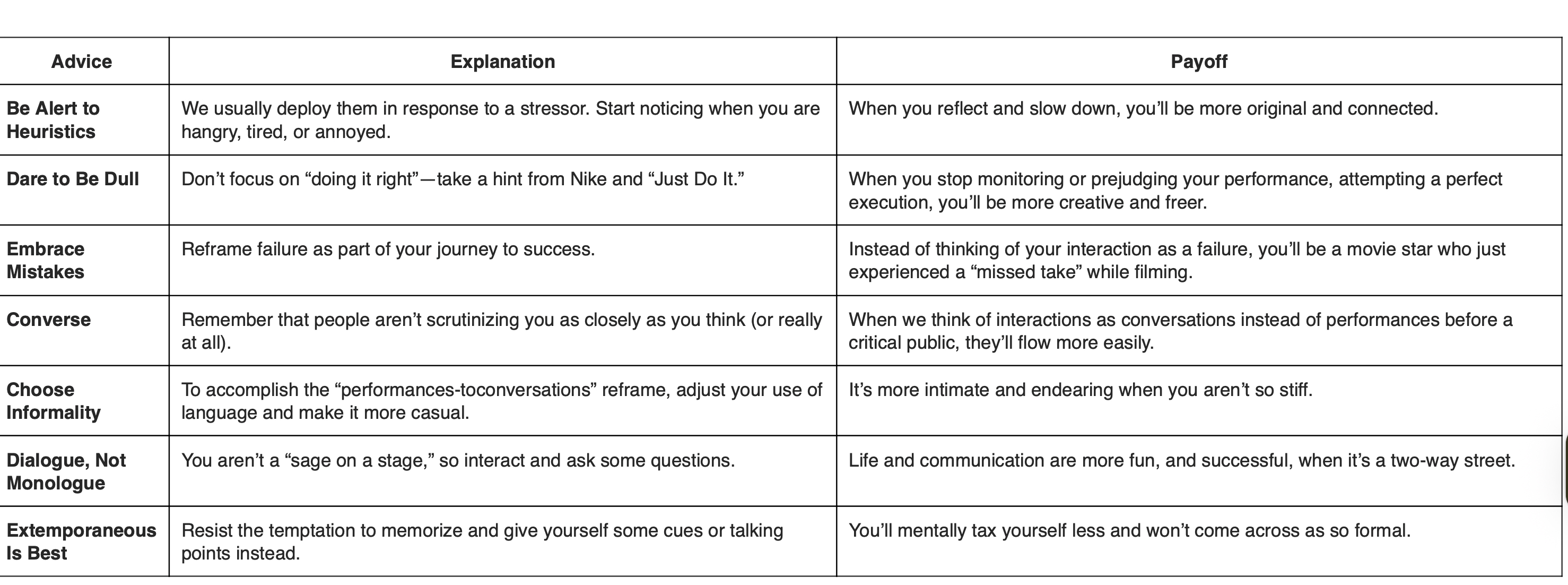
Heuristics = patterns that you have beforehand. For ex. when you practice an story before an interview.
Heuristics limits your creativity.
Breaking your heuristics can create unique situations.
- To become aware of heuristics we should be mindful of situations when we are using them.
- For example in an interview when you get asked a behavioral question, you can become aware of this feeling.
- Challenge: think of typical heuristics you often use when you communicate. Such as starting emails with “I hope you are well.” When you identify it, add an element of novelty that will break it.
- Perfectionism taxes our ability to perform on uncertain situations. The author ask to just let it go. We can’t control it.
“When you’re trying to be original, you sound like everyone else trying to be original. But when you’re obvious, you’re yourself. And that’s what’s genuine.”
Letting it go, being dull and not waiting to say the perfect thing everytime help us be more spontaneous.
- Make spontaneous interaction as conversations rather than monologues.
- Using casual language helps with this.
- Formal language makes us “distant”.
- Casual language (we, simple words) closes the gap between you and you audience.
- Ask more questions to being more closer to the audience.
- Memorization can be a double edged sword. Such as interviews where we’ll likely have to speak spontaneously.
- Creating a bulled pointed outline help us with a structure to fill in the gaps.
- Choose informality.
- Make it a dialogue.
- Observe your mental heuristics. For ex. when people ask you a question, do you tend to say “good question”?
- After an spontaneous exchange with someone, reflect on your selfjudgments. Are you being too harsh on yourself?
Chapter 3
- We perceive speaking situations as threatening to ourselves. But we can change the focus to our audience. That’s a mental shift.
- Improvisation is not about you. Is about the rest of the people, how are they feeling, what do they think.
Q: What’s a mental cue to become more audience centric? A: By being aware of the audience members and the physical enviroment around us.
- The audience wants us to succeed. No one likes to witness social awkwardness.
- From “Yes, but…” or “No” → “Yes, and”.
- This refers to acknowledge what the other person said and keeping the conversation moving forward.
- For example
- When you mess up in a situation, don’t ruminate on the error and move on. Focus on what’s next. You only got control on how you cover.
- It’s all about next play.
Q: What should yo do when u mess up in a situation? A: Reset and focus on the next play.
- Look up the Zen parabole “Chinese Farmer Story”. “Maybe”.